

Wrist Joint Replacement
Schedule Wrist Joint Replacement in New York Today
Book a consultation with Dr. Salil Gupta today to explore wrist joint replacement options tailored to your needs.
Call now or request an appointment online to begin your recovery journey.
Wrist Joint Replacement in New York, Queens, Brooklyn, Manhattan & Long Island | Dr. Salil Gupta
Are you struggling with chronic wrist pain, stiffness, or limited movement due to arthritis? Dr. Salil Gupta a board-certified orthopaedic surgeon, offers advanced wrist joint replacement surgery in New York, Queens, Brooklyn, Manhattan, and Long Island to restore function and relieve pain.
Wrist arthritis can significantly affect your ability to perform everyday activities. When conservative treatments such as medications, splints, or injections no longer provide relief, total wrist arthroplasty (wrist joint replacement) may be the most effective solution.
Dr. Gupta specializes in modern surgical techniques using high-quality implants to help patients regain mobility, reduce pain, and return to an active lifestyle with improved wrist function.
Anatomy of the Wrist
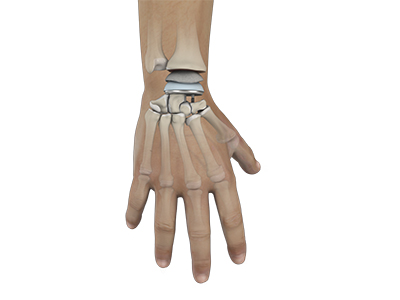
The wrist is a complex joint made up of 8 carpal bones aligned in two rows with four bones present in each row. The carpal bones are further connected to 5 metacarpal bones that form the palm of the hand. Each small bone forms a joint with the bone next to it. Thus, the wrist joint is made up of many small joints. The two bones of the forearm, radius and ulna, also form a joint with the first row of carpals.
The ends of all these bones are covered with a white, shiny material called articular cartilage. Articular cartilage is smooth and has a rubbery consistency. It allows the bones in a joint to move smoothly against each other.
Disease Overview
Injury, infection, and diseases such as osteoarthritis and rheumatoid arthritis can damage or wear out the articular cartilage. This may cause the wrist bones to rub against each other producing pain, stiffness and swelling of the wrist.
Diagnosis
Your doctor diagnoses arthritis of the wrist joint after reviewing your medical history, performing a physical examination and obtaining X-rays. Additionally, blood tests may also be ordered to confirm the presence of rheumatoid arthritis.
Conservative Treatment of Wrist Arthritis
Early treatment is non-surgical and includes:
- Avoiding activities that may aggravate the symptoms
- Immobilization of the affected wrist in a splint
- Using non-steroidal anti-inflammatory drugs (NSAIDs)
- Administering steroid injections into the wrist joint
- Performing specific wrist exercises
What is Wrist Joint Replacement?
Wrist joint replacement surgery, also referred to as total wrist arthroplasty, involves the replacement of a severe arthritic wrist joint with an artificial joint made of metal and plastic components. It relieves pain and restores function when conservative treatment fails to provide relief.
Wrist Joint Replacement Procedure
If non-surgical treatments are ineffective in relieving symptoms, wrist replacement surgery may be considered.
The surgery is performed under general or regional anesthesia. An incision is made over the back of the wrist. The tendons are moved away to expose the wrist joint. Care is taken while moving the nerves to prevent any nerve damage. The damaged joint surfaces of the arm bones are removed with a surgical saw. The first row of carpal bones may also be removed.
The radius bone is hollowed out and a radial component of the prosthesis is fixed inside it with bone cement. Depending upon the design of the prosthesis, the carpal component is placed in the remaining row of carpal bones or into the third metacarpal bone of the hand. The carpal bones may also be linked or fused together to better fix the carpal component. A plastic spacer is then fitted between the metal components.
With the new prosthesis in place, the wrist joint is tested through its range of motion, and is irrigated with a sterile saline solution. The joint capsule is then sutured together. The muscles and tendons are repaired, and put back in place. The incision is closed and the wrist is bandaged with a sterile dressing. Finally, a cast is applied.
After Wrist Joint Replacement
Your arm will be in a cast for the first few weeks after the surgery and you will be prescribed medications to control any pain. Elevating the wrist on a pillow above heart level while sleeping or sitting will help reduce swelling and discomfort. Once the cast is removed, a splint is put for another few weeks. Occupational therapy will also be advised to restore the movement to the wrist joint.
Risks and Complications of Wrist Joint Replacement
Although wrist replacement surgery is considered safe, there are certain risks and complications associated with any type of surgical procedure. Some of the risks and complications may include infection, fracture of the wrist bone, dislocation of the wrist, damage to the nerves or blood vessels, blood clots (deep vein thrombosis), loosening of the implants, wearing off of the implant, and failure to relieve pain.
Outcome of Wrist Joint Replacement
Wrist replacement surgery provides pain relief for patients with severe arthritis of the wrist. It also restores the motion of the wrist to the maximum extent, making it possible to do everyday activities. A wrist replacement usually lasts for about 10 to 15 years. Certain activities that could put extra stress on the new joint or may result in a fall on outstretched hands should be avoided after a wrist replacement.
Why Choose Dr. Salil Gupta for Wrist Joint Replacement in New York?
Choosing an experienced orthopaedic surgeon is essential for successful wrist replacement outcomes. Dr. Salil Gupta provides expert care with a focus on precision, safety, and long-term results.
- Board-Certified Orthopaedic Surgeon with expertise in wrist and hand surgery
- Advanced Surgical Techniques for total wrist arthroplasty
- Personalized Treatment Plans tailored to your condition and lifestyle
- Comprehensive Care from diagnosis to postoperative rehabilitation
- Focus on Pain Relief & Functional Recovery
- Multiple Convenient Locations across New York, Queens, Brooklyn, Manhattan, and Long Island
Dr. Gupta is committed to helping patients regain wrist mobility, reduce pain, and improve quality of life.
Wrist Joint Replacement FAQs
It is a procedure where a damaged wrist joint is replaced with an artificial implant made of metal and plastic to restore function and relieve pain.
Patients with severe wrist arthritis who have not found relief from non-surgical treatments may be candidates.
Initial recovery takes a few weeks, with continued improvement over several months with occupational therapy.
Wrist replacements typically last around 10–15 years, depending on usage and activity level.
High-impact activities or those that place excessive stress on the wrist should be avoided to prolong implant life.
Schedule Wrist Joint Replacement in New York Today
Don’t let severe wrist arthritis limit your daily life. Advanced surgical care can help you regain comfort and mobility.
Book a consultation with Dr. Salil Gupta today to explore wrist joint replacement options tailored to your needs.
- Serving New York, Queens, Brooklyn, Manhattan & Long Island
- Call now or request an appointment online to take the first step toward pain-free movement.


