

Boutonniere Deformity
Have Questions About Hand & Wrist Treatments?
We're here to help you understand your options.
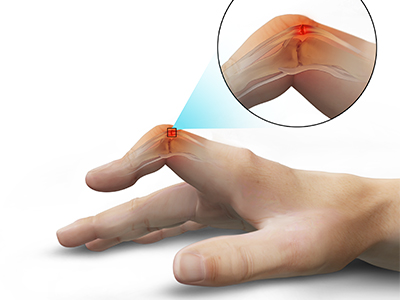
Boutonniere deformity is a finger condition that occurs when the central tendon responsible for straightening the middle joint of the finger becomes injured or damaged. As a result, the middle joint bends inward while the fingertip joint bends backward, creating a characteristic deformity that can interfere with normal hand function. This condition may develop following a traumatic injury, deep cut, sports-related accident, fracture, dislocation, or as a result of chronic inflammatory conditions such as rheumatoid arthritis. Dr. Salil Gupta is a board-certified orthopaedic surgeon specializing in hand and upper extremity care, providing expert diagnosis and treatment for boutonniere deformity.
What is Boutonniere Deformity?
Tendons in your fingers connect the finger bones to finger muscles and help bend and straighten the finger at the joint when the muscles contract. Boutonnière deformity is a condition in which a tendon injury to the middle joint of the finger results in the inability to straighten the affected finger.
Causes of Boutonniere Deformity
Boutonnière deformity can occur because of forceful trauma to the top of the middle joint when bent, laceration to the middle joint or from arthritis.
Symptoms of Boutonniere Deformity
Symptoms associated with this deformity may appear immediately or after a few weeks and may include swelling, pain and restricted movement. In severe cases, a fragment of the bone may be displaced from its original position.
Diagnosis of Boutonniere Deformity
The condition can be diagnosed by a physical examination of the hand, and an X-ray may be ordered to confirm diagnosis.
Treatment for Boutonniere Deformity
Boutonnière deformity can be treated both surgically and non-surgically.
Non-surgical treatments include:
- Application of a splint to the middle joint of the affected finger to straighten it and allow the tendon to heal
- Exercises to improve the flexibility and strength of your fingers
- Protecting your finger by taping it or using protective splints
- Use of oral medications or corticosteroid injections
Surgery is performed when the injury is caused due to rheumatoid arthritis, the tendon is severed, presence of bone displacement or non-surgical treatments fail to provide relief.
Surgical treatments improve the functioning of the finger but may not always correct the appearance, which depends on how soon the surgery is initiated.


